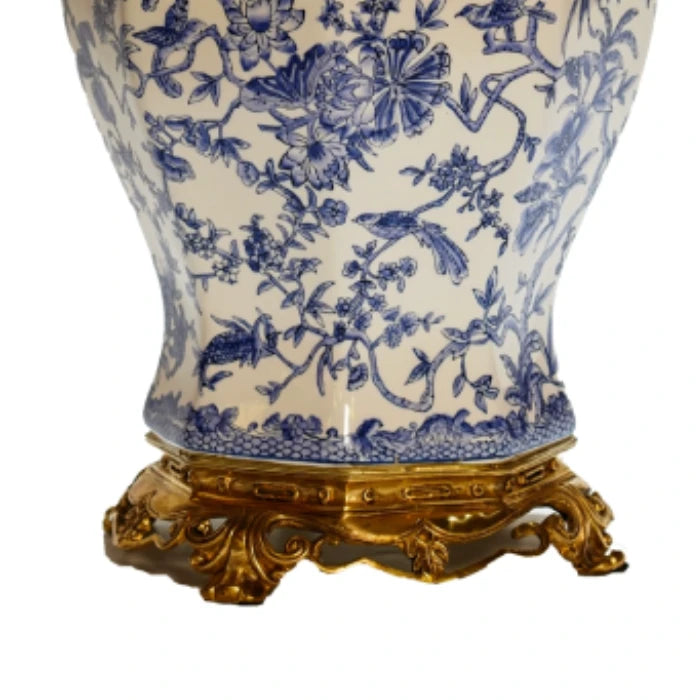
Inspired by the harmonious union of Eastern artistry and Western myth, the Apollonian Ode Ceramic Jar stands as a testament to creative design where the muse of poetry meets the silversmith’s hammer. This piece draws its essence from the legend of Apollo, god of music and prophecy, whose lyre once charmed the heavens into forming the constellation Lyra—a celestial event mirrored in the jar’s elegant form. The white ceramic body, reminiscent of moonlit marble from the quarries of Mount Pentelicus, serves as a canvas for an intricate tableau of blue florals and songbirds. These are not mere patterns but a visual ode: the peony, revered in Eastern lore as the “king of flowers,” here intertwines with olive branches sacred to Athena, symbolizing a dialogue between continents. The birds, poised mid-melody, evoke the myth of Philomela transformed into a nightingale, her eternal song captured in cobalt brushstrokes that dance like starlight on a Grecian urn.The brass elements elevate this decorative ceramic jar into a realm of regal artifice. The three-footed base, sculpted with acanthus scrolls, recalls the sacred tripods of Delphi where priestesses channeled divine prophecy, offering both stability and a sense of ancient ceremony. The gilded band encircling the vessel’s waist echoes the celestial belts of Orion, while the finial atop the dome lid is fashioned as a budding pomegranate—a symbol of Persephone’s bond to the underworld and of eternal return. This creative design ceramic vase transcends mere containment; it is a reliquary for the intangible. Imagine it presiding over a study, holding scrolls or dried florals, its presence evoking the scholars of the Renaissance who blended Hermetic wisdom with imported silks and porcelain. The lustrous brass against the cool ceramic is a play of elements: fire-forged metal embracing earth-sourced clay, much like the alchemical marriage that fascinated medieval minds.As a Chinese ceramic jar reinterpreted through a classical European lens, it bridges the garden pavilions of Suzhou with the colonnaded atriums of Rome. The craftsmanship speaks to a dialogue across time: the delicate blue-and-white palette honors the legacy of the Ming Dynasty’s kilns, while the robust brasswork reflects the grandeur of Baroque metalcraft. This piece does not simply occupy space; it curates an atmosphere. Whether displayed as a solitary icon of beauty or employed as a vessel for precious keepsakes, it invites contemplation on the unity of artistic traditions. In its curves and motifs reside stories of oracle birds, Olympian gardens, and the silent music of the spheres—a symphony for the eyes, perfect for those who seek depth and narrative in their sanctuary.
Subscribe to our emails
Subscribe to our mailing list for insider news, product launches, and more.
Choosing a selection results in a full page refresh.